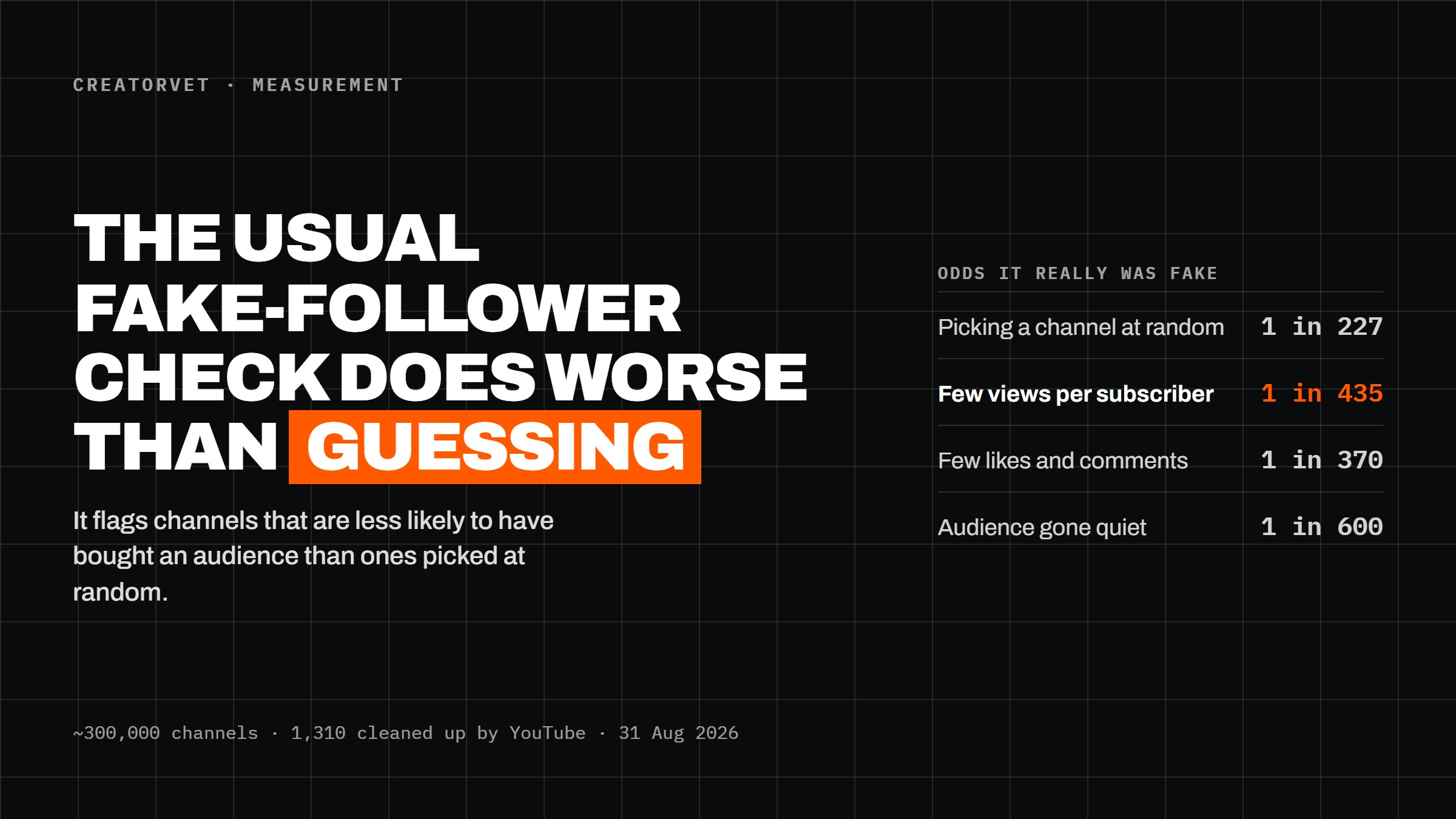
There is one rule almost everybody uses to spot a creator with a fake audience. We finally had a way to check whether it works. It doesn't. It gets the answer wrong more often than guessing would.
The rule
You are about to pay a YouTuber to talk about your product. Someone on the team pulls up the channel and says: "Hang on — a million subscribers, but only five thousand people watch each video? Those subscribers must be bought."
It sounds obviously right. Real fans watch. Fake ones don't. So if the views look small next to the subscriber count, something is off.
That rule is in every vetting checklist we have seen. It is the first thing most tools show you. And as far as we can tell, nobody had ever checked it against a case where the answer was known.
Where the answers came from
Normally you can't check. No creator announces that they bought followers, so most audience-quality scores are built on reasoning that sounds sensible and is never tested.
There is one exception, and it is the reason this article exists. YouTube itself deletes fake subscribers. Every so often it sweeps through and removes accounts it has decided are bots. When that happens, the channel's subscriber count goes down.
A subscriber count going down is not a hint. It is YouTube telling you, in public, that this channel had fake subscribers and they have now been removed.
So we had a marked exam paper. Find the channels YouTube cleaned up, then go back and ask: did the famous rule spot them beforehand?
Counting carefully
One wrinkle first. YouTube doesn't show you the exact number of subscribers a channel has. It rounds: 1,234,567 shows up as 1.23M. So the number you can see wobbles and steps rather than moving smoothly, and a small dip usually means nothing at all.
We only counted a drop as real if it was much bigger than that rounding could explain — more than 30,000 subscribers lost on a channel of about a million, more than 300 on a channel of about ten thousand. That is a deliberately high bar. It throws away plenty of genuine clean-ups so that everything left is beyond argument.
Across roughly 300,000 channels we watched every day, that left 1,310 channels that YouTube definitely cleaned up.
Which gives us the number everything else is judged against: if you picked a channel at random, the chance it had fake subscribers removed was about 1 in 227.
What we were looking for
A useful warning light should beat that. If a check flags a channel, the odds it really did have fake subscribers ought to be better than 1 in 227 — otherwise the check is just decoration.
Three things can happen:
- Better than 1 in 227. The check is doing something. The bigger the gap, the more useful.
- About 1 in 227. The check tells you nothing. You may as well flip a coin.
- Worse than 1 in 227. This is the strange one. The channels it points at are less likely to be fake than ones picked blindly — like a smoke alarm that goes off in the rooms that aren't burning.
What we found
| What the check looks at | Channels it flagged | How many really were cleaned up | Verdict |
|---|---|---|---|
| A sudden jump in subscribers | ~1,300 | 1 in 6 | Works well |
| Few likes and comments | ~23,000 | 1 in 370 | Wrong way |
| Few views per subscriber | ~25,000 | 1 in 435 | Wrong way |
| Audience gone quiet | ~7,200 | 1 in 600 | Wrong way |
The famous rule — few views per subscriber — flagged about 25,000 channels, and only 1 in 435 of them turned out to have fake subscribers. Picking a channel blindfolded would have done better.
The other two ratio-based checks came out the same way. Only one thing on the list actually worked, and it wasn't a ratio at all. More on that in a moment.
Why the rule fails
This isn't bad luck or a small sample. The number is mostly measuring something else entirely, and there is a neat way to show it.
Take the same 143,000 channels. Line them up by subscriber count, smallest to largest, and views-per-subscriber falls off a cliff. Now line up the very same channels by how many people actually watch them, and the identical number climbs just as steeply in the other direction.
The same channels, sorted two ways
Views per subscriber. Same 143,000 channels and the same number both times — only the order changes.
A number that flips direction depending on how you sort the list isn't telling you about the channels. It is telling you about the sorting.
The gym membership problem
Here is what is going on underneath.
A subscriber count is a running total of everyone who ever pressed subscribe. YouTube adds to it when someone joins, and never takes anyone off when they lose interest, move on, or forget the channel exists.
Think of a gym that counts everyone who has ever signed up and never removes anyone who stopped coming. After ten years that membership list tells you a great deal about how long the gym has been open, and almost nothing about how busy it is on a Tuesday night.
So dividing views by subscribers mostly measures how old a channel is. Older channels have been collecting dormant subscribers for years, so their ratio looks terrible. And older, established channels are among the least likely to have bought an audience — they didn't need to.
That is how a sensible-sounding rule ends up pointing backwards.
What we are not claiming
We would rather say this ourselves than have it pointed out.
The one check that worked is a genuine prediction: we measured it using only what the channel looked like before YouTube cleaned it up, so it never got to peek at the answer.
The three that failed were measured differently. We know what those channels look like today, not what they looked like the week before the clean-up, because we don't yet keep a daily record of likes and comments. So they are strong evidence that these numbers don't separate real audiences from bought ones — but we are not calling them predictions, and we will not until the record supports it.
Two more honest limits. We have about two months of daily history, so a clean-up spread slowly over many weeks might slip past our bar. And any channel sitting on fake subscribers that YouTube hasn't got to yet counts as clean in our exam paper — which means the real amount of fakery out there is higher than what we measured, not lower.
So what should you do instead?
Stop treating views-per-subscriber as a fraud test. It is a reasonable rough guide to whether a channel's audience is still paying attention, and that is genuinely worth knowing before you pay someone. Just call it what it is — a sign of a quiet audience, not a bought one.
The check that did work looks at something completely different: not how big the numbers are, but how they moved. That one is in the next article.