A brand pays a creator, the video goes out, everyone says it went well. Then what? Nobody seems to have a number for how often the brand comes back. We went and counted, across 108,000 creator–brand relationships.
The question
If you make videos, this is the number that decides whether sponsorship is a job or a lottery. One deal is a nice month. The same brand coming back three times is a business.
If you are buying, it is the number behind a quieter question: when someone tells you a creator is "proven with brands in your space", is that one video from eighteen months ago, or an actual ongoing relationship?
Everyone has an anecdote. We could not find anyone with a count.
How we counted
We track sponsorships across a large slice of YouTube. Grouping them by relationship rather than by video gives 108,433 creator–brand pairs: one line per "this brand worked with this creator", however many videos that turned out to be.
Then one question per line — did it happen more than once?
Two rules kept that honest. A repeat needs two different days, because a creator publishing two videos on the same Tuesday with the same link in both has been booked once, not twice. And the stricter column needs three different months, which almost nothing but a genuine repeat booking will clear.
What counts as a real booking
This part changes the answer, so it is worth a moment.
Not every brand mentioned in a description is a sponsorship. Some are commission links. Some are the creator's own company. Some are a brand named once in passing. We can tell these apart to different degrees of confidence, so rather than pick one definition and hide the choice, here is the same question answered four ways — loosest at the top, strictest at the bottom.
| What counts as a booking | Relationships | Booked again | Ran 3+ months | Avg times |
|---|---|---|---|---|
| Every detected sponsorship | 108,433 | 38.5% | 12.4% | 3.2 |
| Minus commission links and own-brand | 93,235 | 37.0% | 12.1% | 3.0 |
| Verified third-party sponsor | 19,179 | 40.8% | 16.0% | 3.4 |
| + the creator declared it paid | 8,578 | 49.2% | 23.6% | 3.9 |
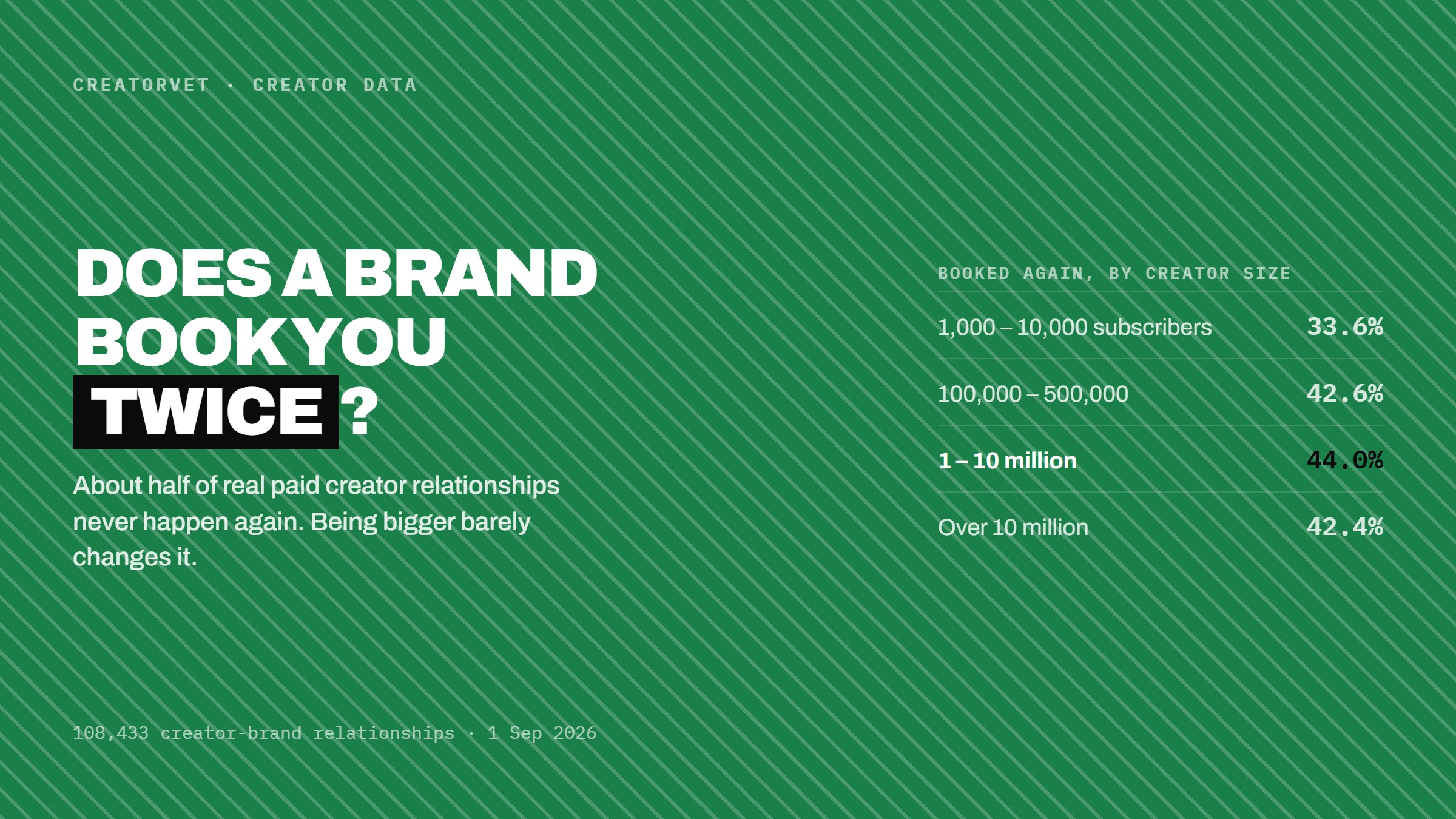
On the strictest definition, about half of real paid creator relationships happen more than once.
Half come back. Half do not. And where a brand does come back, it comes back about four times on average, with roughly a quarter of relationships still running three months later.
The bit we got wrong
We expected the opposite of what happened, and it is the most useful thing in the data.
Our assumption going in: loose counting would inflate loyalty. A commission link sits in a creator's description template for months, appearing on video after video, looking like a brand that keeps coming back when really nobody agreed to anything. Tighten the definition, we thought, and the repeat rate should fall.
It rose. From 38.5% to 49.2%.
The reason is what the loose pile is actually full of: one-off mentions. A brand named once in passing. A single code in a single video. A partnership that happened exactly one time. There are tens of thousands of those, and they are almost all singletons.
Strip them out and the real relationships underneath turn out to be stickier than the average suggested. So the noise was making the category look less loyal, not more — which is worth knowing before you quote anybody's "creator retention" figure, including ours.
Do bigger creators get booked again more?
Slightly. And the size of "slightly" is the point.
| Creator size | Relationships | Booked again |
|---|---|---|
| 1,000 – 10,000 subscribers | 1,662 | 33.6% |
| 10,000 – 100,000 | 4,938 | 39.6% |
| 100,000 – 500,000 | 5,997 | 42.6% |
| 500,000 – 1 million | 2,121 | 43.9% |
| 1 – 10 million | 3,599 | 44.0% |
| Over 10 million | 340 | 42.4% |
Bigger creators are booked again — barely
Share of creator–brand relationships that ran more than once, by creator size.
From the smallest tier to the largest, the chance of being booked again rises from about a third to about 44% — and then dips a little at the very top. Across creators whose audiences differ by a factor of ten thousand, the relationship difference is about 1.3×.
That shape is not a surprise if you have read any marketing science. Bigger brands in almost every category are bought slightly more often as well as by more people — the effect is real and it is always small. It turns out to hold for creators being bought by brands, which as far as we can tell nobody had checked.
The practical version: size buys you reach, not loyalty. A channel ten thousand times bigger gets in front of vastly more people, and is only marginally more likely to see the same brand again.
What we would do with this
If you make videos: plan for the one-off. Half of relationships are single deals, so treat every sponsored video as the audition it actually is — and know that a second booking puts you in the better half. Roughly a quarter of relationships are still going after three months; those are the ones worth protecting.
If you are buying: "we have worked with them before" is true of about half the market, so it is a weak signal on its own. The stronger question is how many times, and over how long. Four bookings across three months is a working relationship. One video in March is a trial someone did not repeat.
If you are choosing between creators: do not pay a premium for the loyalty of a large channel. It is barely there. Pay for what does change with size, which is how many people actually watch.
What this does not tell you
Our window is under five months. A brand that books the same creator every quarter shows up here as a repeat; one that books once a year looks like a one-off. So this measures short-run re-booking, and the true annual rate is higher than the numbers above.
The strictest row also leans on our own verification of who is a genuine third-party sponsor, and that verification currently covers about a third of relationships — skewed towards channels we have been tracking longest, which are older and more established. Since established creators get booked again more often, 49.2% is more likely to be a little high than a little low.
We would rather publish that than round it off. The direction of the error is knowable, so it should be stated.