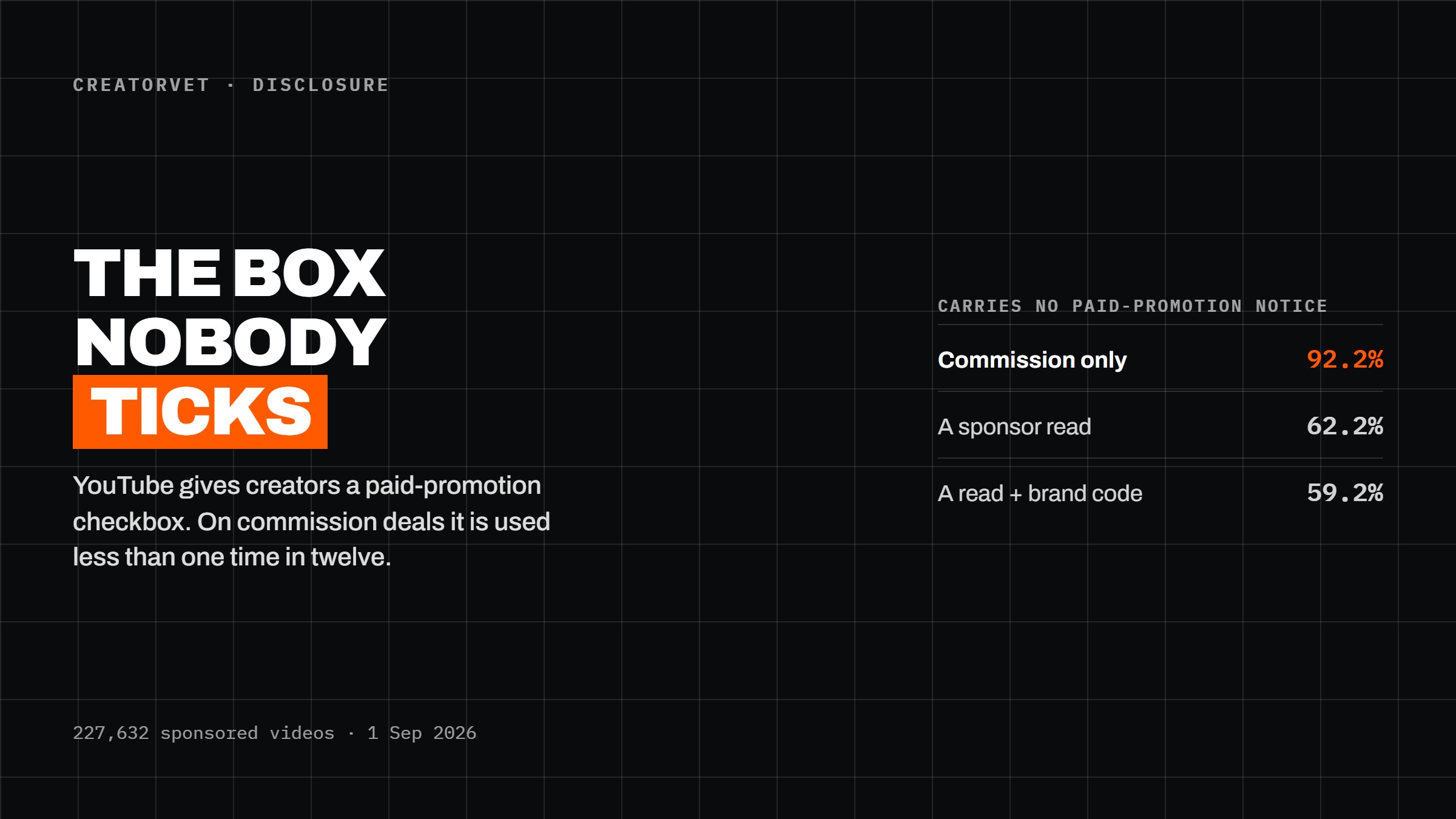
YouTube gives every creator a checkbox that says "this video contains paid promotion". We looked at 227,632 videos where we could see a sponsorship, and counted how many had it ticked. The answer depends entirely on what kind of deal it was — and one kind almost never gets declared.
The box
When a creator uploads, there is a setting labelled "Paid promotion". Ticking it puts a small "Includes paid promotion" notice on the video for the first few seconds.
It is not decoration. Advertising regulators in most markets require a material connection between a creator and a brand to be made obvious to the viewer. The box is the platform's built-in way of doing that.
So: when we can see that a video is carrying a sponsorship, how often is the box ticked?
Why we can answer this
Two things have to be true, and both are.
First, we can detect sponsorships independently — from the wording, a brand-issued discount code, or a link on the brand's own domain. That gives 227,632 videos where a commercial arrangement is visible in the video's own description.
Second, and this is what makes it measurable: the paid-promotion setting is recorded on essentially every one of those videos. It is not missing data that we are guessing around. Every video in this set was asked the question and gave an answer.
The answer, split by deal type
This is where it gets interesting, and where a single headline number would have been misleading. Sponsorships are not all the same kind of arrangement, and the two main kinds behave completely differently.
| Kind of deal | Videos | Box ticked | No disclosure |
|---|---|---|---|
| Commission only — creator earns a cut of sales | 97,330 | 7.8% | 92.2% |
| A sponsor read — dedicated or integrated segment | 130,295 | 37.8% | 62.2% |
| A read with the brand's own discount code | 56,114 | 40.8% | 59.2% |
How often the paid-promotion box is ticked
Each bar is 100% of that deal type. The orange share carries no platform-level disclosure.
The commission gap
When a creator earns commission on what you buy, the box is ticked less than one time in twelve.
92.2% of commission-only videos carry no paid-promotion notice.
There is a comfortable story about why, and it is worth saying out loud so it can be dismissed: a lot of creators seem to believe a commission link is not really a sponsorship. Nobody paid a fee. There was no contract. It is just a link, and if nobody buys anything the creator earns nothing.
That reasoning is wrong in exactly the way that matters. The rules are about a material connection between the recommender and the thing recommended — and "I earn money if you buy this" is about as material as a connection gets. If anything, a commission gives a creator a sharper incentive than a flat fee does, because their earnings depend on persuading you.
The part that is harder to explain away
You could argue the commission number is a definitional muddle. The next one is not.
Take only videos with a dedicated or integrated sponsor read — the creator stops and talks about the product, or the whole video is the promotion — and a discount code issued by that same brand. A code is not something a creator can make up. The brand generated it, tracks it, and pays against it.
That is a commercial arrangement by construction. There is no reading of those 56,114 videos where nothing was agreed.
Nearly 6 in 10 of them carry no paid-promotion disclosure.
And notice the direction of travel across the table: the more certain we are that a real deal happened, the more often the box is ticked — 7.8%, then 37.8%, then 40.8%. That is a good sign for the measurement, because it means the flag is behaving sensibly rather than randomly. It also means the true picture for unambiguous paid deals is the 59.2% figure, not the 92%.
What we are not saying
Two limits, both of which cut against our own headline. We would rather state them than have them pointed out.
An unticked box is not proof nobody disclosed anything. A creator can say "this video is sponsored by…" out loud, or put text on screen, and satisfy the spirit and often the letter of the rules without ever touching the setting. What we are measuring is the platform's own disclosure mechanism, not every possible form of disclosure. The honest phrasing is "no platform-level disclosure", and we have kept to it.
Our detection is not perfect. If we read something as a sponsorship that was not one, the denominator inflates and the gap looks worse than it is. That is precisely why the table splits by how certain the arrangement is — and the finding survives at the strictest end, where a brand code and a sponsor read appear on the same entry.
Why it matters to whoever is paying
If you are a brand, this is not the creator's problem. It is yours.
Advertising regulators pursue the advertiser, not just the publisher. A campaign where most placements carry no platform disclosure is exposure sitting on your side of the table, created by people you paid and largely invisible to you unless somebody goes and looks.
And it is checkable before the money moves, not after. Whether a creator's past sponsored videos were declared is a matter of public record on every one of them. It is a five-second check that approximately nobody runs.
The uncomfortable version of this finding: if roughly six in ten unambiguous paid reads go undeclared at platform level, then a brand picking creators at random is more likely than not to be buying into that pattern.