"Smaller creators have more engaged audiences" is one of the most repeated lines in influencer marketing. It is the whole reason brands pay a premium for tiny channels. We checked it across about 143,000 of them. Mostly, it isn't true — and where it is true, it's true for reasons nobody mentions.
The claim
You have heard the pitch. A creator with 8,000 subscribers has a real community who know them by name. One with eight million has a crowd who scroll past. So pay less, get more warmth per view, and work with lots of small people instead of one big one.
It is a nice story and it moves a lot of money. It is also the kind of claim you can just go and check.
What "engaged" actually means here
When people say engagement they usually mean this: of everyone who watched a video, what share bothered to like or comment on it. Ten thousand views and three hundred likes is 3%.
It is a fair thing to care about. A video people watch and immediately forget is worth less than one they react to.
The result
We sorted all 143,000 channels by how many people actually watch them, then split them into ten equal groups — the smallest tenth, the next tenth, and so on up to the biggest.
The gap between the ends is enormous. A typical channel in the smallest group gets about 2,800 views a month. In the biggest group, about 6.8 million. That is roughly 2,500 times more people.
And engagement across that entire range? It goes from 3.06% down to 2.06%.
The audience gets bigger. It does not get less keen.
The same ten groups of channels, smallest to biggest, measured two ways.
The audience gets vastly bigger. It barely gets less enthusiastic.
There is a real decline at the very top, and we are not going to wave it away. But "the very biggest channels get a bit less reaction" is a far smaller claim than "small creators have dramatically more engaged audiences" — and it is the second one people are being charged for.
The bit that surprised us
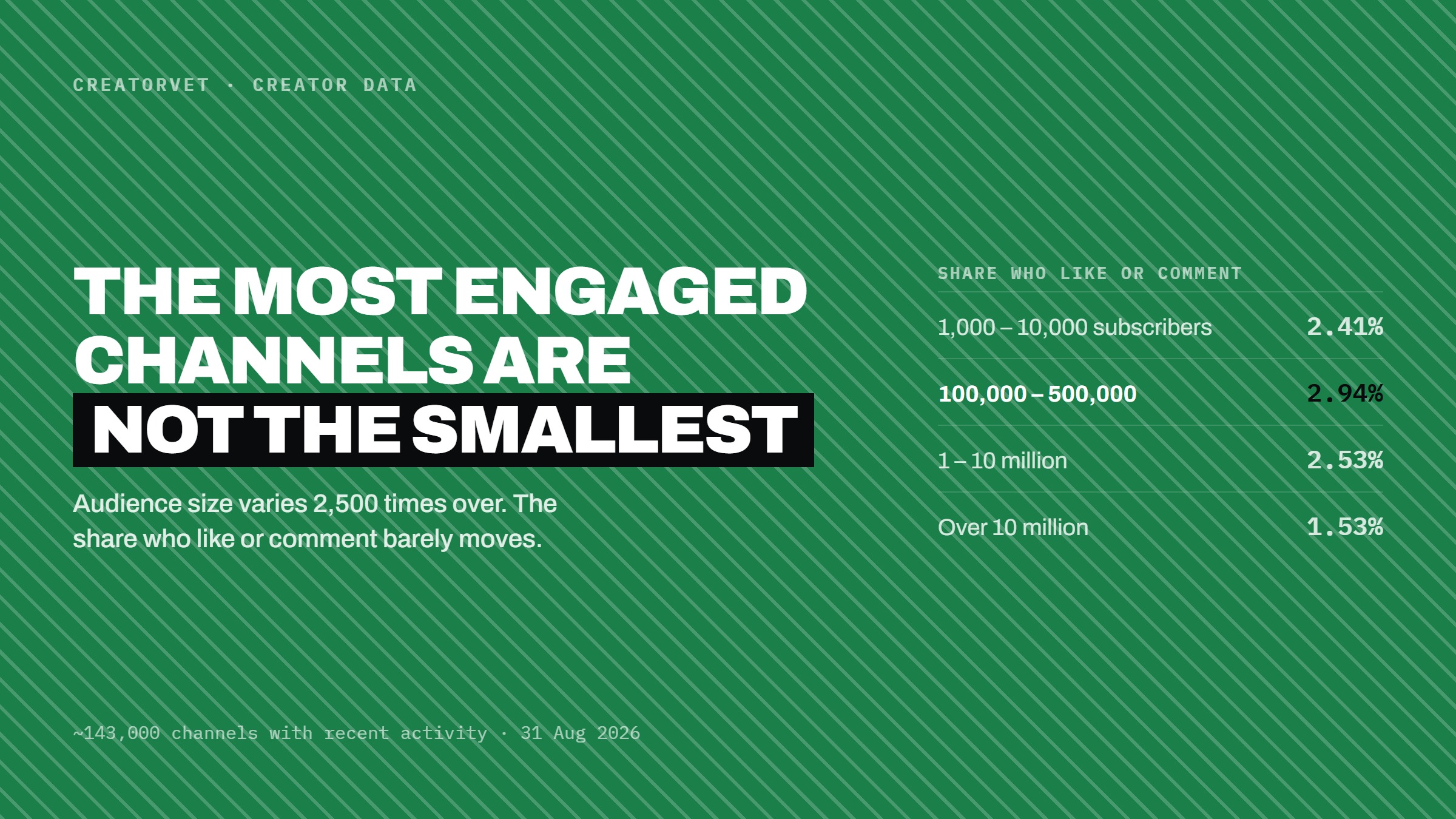
Sort by subscriber count instead, and engagement doesn't slide downwards at all. It rises through the small and middle sizes, peaks, and only then falls:
| Channel size | Typical engagement |
|---|---|
| 1,000 – 10,000 subscribers | 2.41% |
| 10,000 – 100,000 | 2.80% |
| 100,000 – 500,000 | 2.94% |
| 500,000 – 1 million | 2.86% |
| 1 – 10 million | 2.53% |
| Over 10 million | 1.53% |
The most engaged channels are not the smallest ones. They are the ones in the middle, around a few hundred thousand subscribers. The very smallest channels score below them.
Whatever is behind the small-creator premium, "their audiences react more than everyone else's" isn't it.
It depends enormously on what they make
Here is the part we would actually act on. Averages across all of YouTube hide the useful bit, because different subjects behave completely differently:
| Subject | Smallest channels | Biggest channels | Difference |
|---|---|---|---|
| Technology | 2.57% | 2.63% | None |
| Cars | 2.28% | 2.23% | None |
| Pop culture | 3.22% | 2.47% | Small |
| Gaming | 3.99% | 2.35% | Noticeable |
| Hobbies | 3.58% | 1.79% | Halves |
| Music | 3.79% | 1.73% | Halves |
In technology and cars, size makes no difference at all to engagement. A huge tech channel gets the same reaction rate as a tiny one. Paying a premium for a small tech creator on engagement grounds is paying for something that isn't there.
In music and hobbies, engagement genuinely does roughly halve as channels get bigger. There, the small-creator argument has something behind it.
So the honest version isn't "small creators engage better" or "small creators don't engage better". It is: in some subjects it matters a lot, in others not at all — and a plan built on the overall average will be wrong in both directions at once.
Likes and comments aren't the same thing
One more thing worth knowing, because it changes which number to trust.
Split engagement into its two halves and they behave very differently as channels grow. The share of viewers who like a video barely changes. The share who comment falls off sharply — by about five and a half times across the same range.
Comments are a much bigger ask than a like, and on a huge channel a comment feels like shouting into a stadium. So if your engagement number leans on comments, you are mostly measuring channel size wearing a disguise, and comparing a small creator's comment rate to a big one's is close to meaningless.
What to do with this
Engagement rate sits between roughly 2% and 3% for almost everybody. It is a narrow band, which means it can't do much to separate one creator from another — most of the wobble inside it is noise, not a signal about audience quality.
Two things do vary hugely, and are worth choosing on. The first is how many people actually watch — that spans a factor of 2,500, and it is the thing you are really buying. The second is how a creator compares to others making the same kind of content, because a typical cooking channel and a typical finance channel sit in genuinely different places, and judging both against one number punishes whole subjects for no reason.