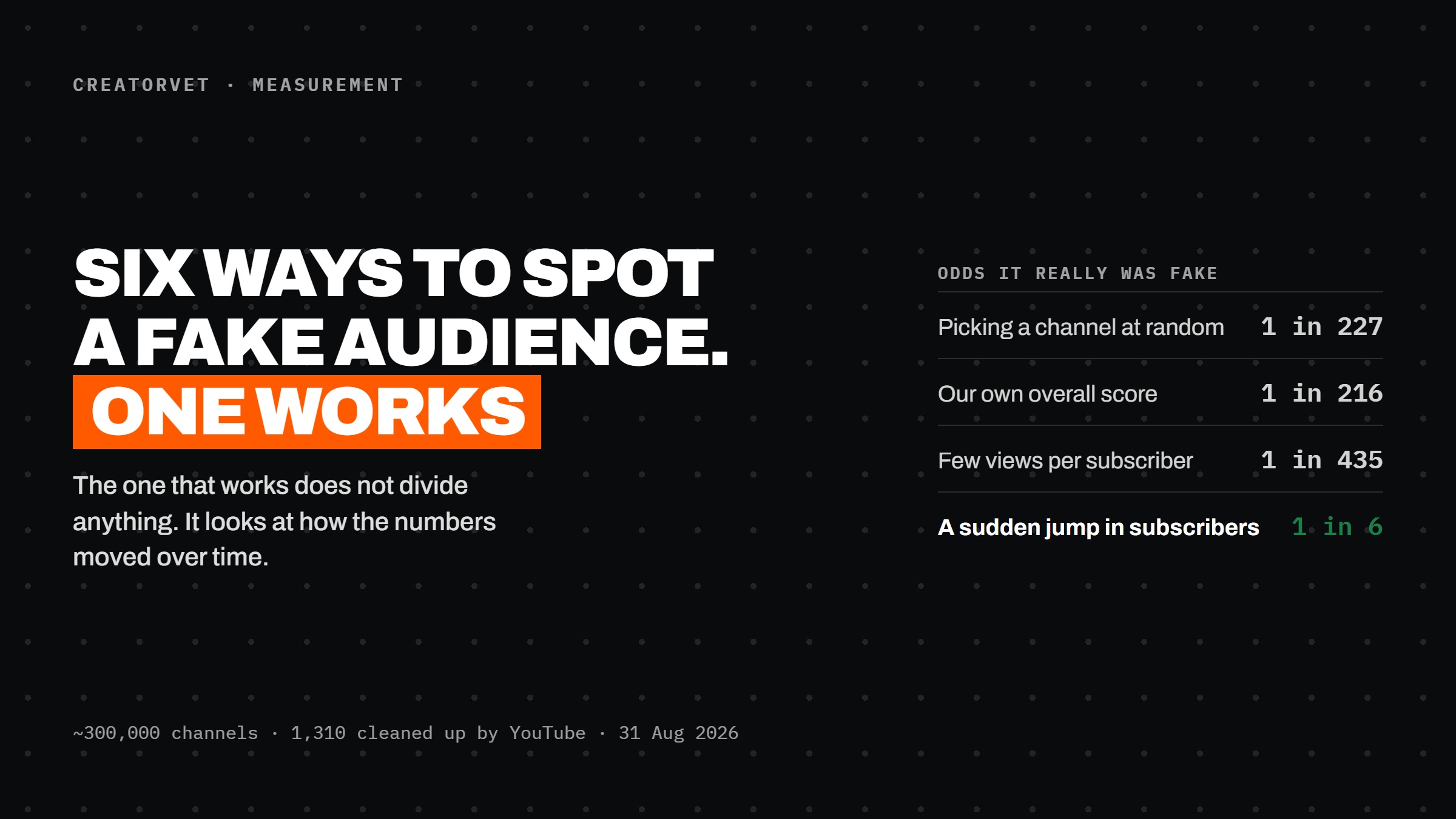
We put six popular ways of spotting a fake audience through the same test. Three point the wrong way. One has quietly stopped working. One is genuinely good — and it isn't the one anybody talks about.
The test, briefly
YouTube deletes fake subscribers in sweeps. When it does, the channel's subscriber count drops. A drop is therefore YouTube telling you in public that this channel had fakes, and that they are now gone. That gives us a marked exam paper — the full setup is in the previous article.
About 300,000 channels watched daily. 1,310 of them cleaned up by YouTube. So if you picked a channel at random, the odds it had fakes removed were roughly 1 in 227. Every check below is judged against that single number: does it beat picking blindly, or not?
The one that works: a sudden jump
Watch how a channel gains subscribers day by day. Real growth is bumpy — a video does well, the next week is quiet, someone shares an old clip — but it stays in a range. A channel that usually picks up 500 a day might have a good day of 2,000.
Bought subscribers don't trickle in. They arrive all at once, like a bus pulling up. That same channel suddenly gains 40,000 in a single day.
So the check is simply: was there a day wildly out of line with this channel's own normal? Not compared with other channels — compared with itself. A big channel and a small one each get judged against their own habits.
It is also a real prediction rather than hindsight. We only looked at what a channel did before YouTube cleaned it up, so the check never got to see the answer it was being asked for.
The three that point the wrong way
Every check that works by dividing one number by another came out backwards — the channels it flagged were less likely to be fake than ones picked at random.
Which warning signs actually work
How much better than guessing each check does. Guessing sits on the dotted line.
| What it looks at | Flagged channels that really were fake | Verdict |
|---|---|---|
| A sudden jump in subscribers | 1 in 6 | Works well |
| Few likes and comments | 1 in 370 | Wrong way |
| Few views per subscriber | 1 in 435 | Wrong way |
| Audience gone quiet | 1 in 600 | Wrong way |
There is a pattern in which ones failed, and it is worth seeing.
Every failed check either divides by the subscriber count or looks at a single moment in time. Both are dominated by how long a channel has been going rather than whether its audience is real. A ten-year-old channel has a decade of people who signed up and drifted away, so its ratios look bad — and a ten-year-old channel is one of the least likely to have bought anything.
The check that worked isn't a ratio at all. It looks at how the numbers moved over time. Buying an audience is an event, and events leave a mark in a timeline. They don't reliably show up in a snapshot.
The alarm that stopped ringing
One more finding, and it is a different sort of problem.
Our own strictest warning — the one that says avoid this creator — went off for 37 channels out of roughly 300,000. About one in eight thousand.
It caught none of the 1,310 clean-ups. We want to be careful here, because that sounds worse than it is: at odds of 1 in 227 you would expect fewer than one fake channel in a group of 37 anyway. The group is far too small to judge the warning either way.
What it does show is that the bar had been set so high the warning had effectively stopped being given. An alarm that almost never rings isn't protecting anybody — and that kind of failure is much harder to spot than a wrong answer, because a silent alarm and a clean roster look exactly the same.
What we can't tell you yet
Only the sudden-jump result is a true prediction. The three that failed were measured from how those channels look now, not from how they looked the week before the clean-up, because we don't yet keep a daily record of likes and comments. That is enough to show those numbers don't separate real audiences from bought ones. It isn't enough to call them predictions, and we won't pretend otherwise.
We also have only about two months of daily history, so a slow clean-up spread over many weeks might not trip our bar. And any channel sitting on fake subscribers that YouTube hasn't swept yet counts as clean in our exam paper — so the real amount of fakery is higher than the 1 in 227 we measured, not lower.
What we changed because of it
Views-per-subscriber no longer decides whether a creator gets flagged. It sits in the report as what it actually is — a sign of how awake a channel's audience is. Worth knowing before you pay someone; just not evidence that anybody bought anything.
And a verdict is only given when a check has genuinely run. Where there isn't enough history to judge, the report says so instead of saying "clean". A confident all-clear on a channel nobody actually measured is the most expensive thing a vetting tool can produce.
The test itself is now a script we can re-run rather than a result somebody remembers, so it gets checked again as the data grows. That is the part we would encourage anyone selling audience scores to copy — not our thresholds, but the habit of testing them against something that could prove them wrong.