Agencies sell line-ups. "These creators fit your brand." Do rival advertisers really hire different kinds of creator? We checked 2,725 of them. Then we dealt the same creators back out at random. Almost nothing changed.
The claim we wanted to test
Two energy drink brands both sponsor YouTubers. Do they hire different sorts of people?
The industry assumes yes. That assumption is what a targeting deck is made of. It is also what justifies the line "we found creators uniquely aligned with you".
So we counted. Every tracked sponsorship, grouped by advertiser. That is 230,237 sponsored videos and 109,875 creator–brand relationships. It leaves 2,725 advertisers who hired five or more creators, across 26 topics.
Each advertiser gets four facts about the creators it hired. How big they are. What country they are in. What else they post about. How much their audience likes and comments.
Then one question. How far does each advertiser sit from the average for its topic?
The first answer was wrong
The gap came out at 10.8 points. Big. Advertisers look very different from each other.
That number is worthless, and here is why.
Two coffee shops
Two coffee shops on the same street. Count who walks in today.
| Customers | Men | Women | |
|---|---|---|---|
| Shop A | 8 | 5 | 3 |
| Shop B | 8 | 3 | 5 |
Of course not. You served eight people. Flip a coin eight times and you get splits like that all day long.
Now give each shop 4,000 customers and the same percentages. Now it means something. Nothing changed except how many people you counted.
An advertiser who hired eight creators is the eight-customer coffee shop.
This is the whole problem. The research that made "rival brands sell to the same people" famous counted thousands of buyers per brand. Our advertisers hire between five and fifty creators.
It gets worse. Say you sort creators into six size bands. An advertiser who hired eight creators can only ever be at 0%, 12.5%, 25%, 37.5% and so on.
There is no way for them to land on 15%. It is arithmetically impossible. So they have to look unusual, before making a single decision.
So we dealt the cards again
How different would these advertisers look if they picked at random? Only one way to find out. Make them.
Take every creator hired inside one topic. Put them all in a hat. Deal them back out to the same advertisers at random, keeping the counts identical. An advertiser who hired twelve gets twelve random ones.
Measure the gap again. Two hundred times per topic, averaged.
The random version has no strategy, no taste and no brief. Whatever gap survives there is pure luck. Anything above it is a real decision.
Most of the gap between advertisers is luck
How far the average advertiser sits from its topic’s norm — and how much of that the same advertisers produce when the creators are dealt out at random.
What came back
| What we compared | Real advertisers | Dealt at random | Actually real |
|---|---|---|---|
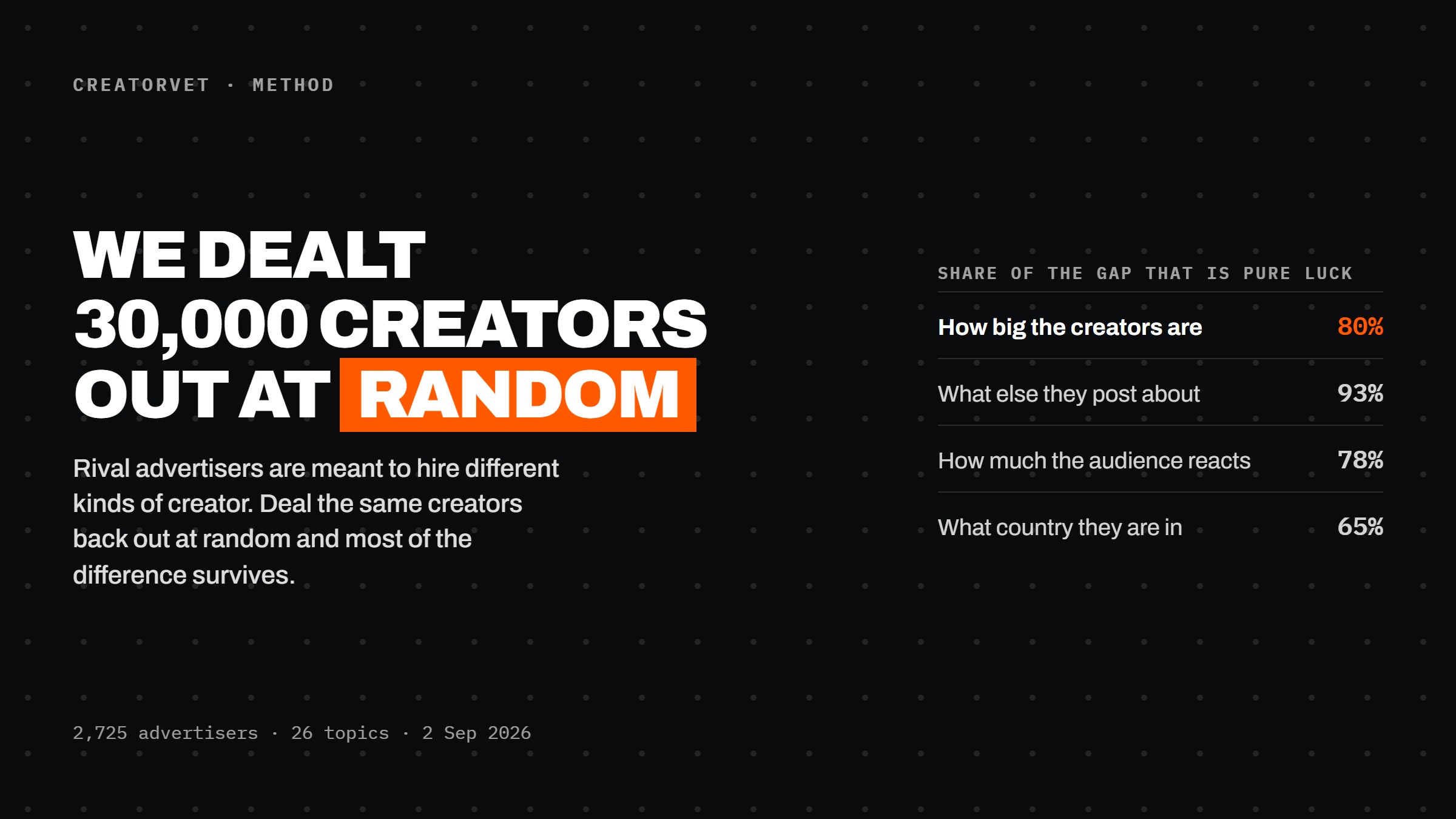
| How big the creators are | 10.8 | 8.6 | 2.2 |
| What country they are in | 9.4 | 6.1 | 3.3 |
| What else they post about | 18.0 | 16.8 | 1.3 |
| How much the audience reacts | 14.0 | 10.9 | 3.1 |
Read the last column. Nothing above 3.3.
Between 65% and 93% of the difference between advertisers was luck. Rival advertisers hire the same kinds of creator. They hire different numbers of them.
A stricter definition of a sponsorship cuts the sample from 2,725 advertisers to 149. The four numbers come back 2.0, 2.8, 3.1 and 2.7. An eighteen-fold smaller sample, same answer.
The one real difference is a passport
Country had the biggest genuine gap. So we looked at which topics it came from.
Money, education and careers. And the countries driving it were India, the United States, the UK and Pakistan.
That is not taste. That is a licence.
An Indian banking app hires Indian creators because India is where it is allowed to operate. Nobody in that room debated brand alignment. The only real difference between advertisers is where they are permitted to sell.
Is anyone genuinely picky?
Some are. Each advertiser is scored against its own random version. One that hired eight gets compared to random groups of eight. Small line-ups get no free credit for looking erratic.
| Genuinely choosing | 9% |
| Possibly choosing | 19% |
| What pure luck would produce | 2% |
So about one advertiser in five is really choosing. The other four in five hire a completely ordinary spread, whatever the deck said.
The trap this sets
Here is the part worth taking away, because it will show up in somebody's dashboard soon.
Take the advertisers that looked most unusual. Group them by how many creators they hired.
| Creators hired | How unusual they look | How sure we can be |
|---|---|---|
| 5 to 9 | 28.6 | 4.9 |
| 10 to 24 | 19.3 | 5.5 |
| 25 to 49 | 15.2 | 6.1 |
| 50 to 99 | 12.4 | 6.8 |
| 100 to 249 | 10.8 | 8.2 |
| 250 or more | 10.7 | 12.3 |
The fewer creators you hire, the more unusual you look. Every single time.
Rank advertisers by how distinctive their line-up looks and you have mostly ranked them by how few people they hired.
A report built that way calls the tiny accounts brilliant strategists and the big spenders unfocused. The truth points the other way.
If you are buying
Two things change.
Nobody has locked up the good creators. Your competitor's line-up is not a moat. Four advertisers in five hire an ordinary spread. Those creators are available, and nothing structural stands in your way.
Ask what a fit claim is measured against. "These creators fit your brand" is a testable sentence. Fit compared to what — the topic average, or nothing? If the answer is nothing, the claim is a coin flip with a slide behind it.
If you make videos
You are less boxed in than the pitch decks suggest. Four in five advertisers hire an ordinary spread. So the brands hiring creators like you are not doing it because of something you lack.
The exception is worth knowing too. Where you are matters, because some advertisers legally cannot hire outside their market. That is not a judgement on your channel.
What this does not tell you
It says nothing about audiences. This measures which creators an advertiser hires, not who watches them. YouTube publishes no audience make-up for channels you do not own. Modelling it and calling it measured is not something this site will do, so the audience version stays unanswered.
Topics come from a keyword classifier. Creators are sorted automatically. Good enough to group competitors together. Not hand-checked.
Small topics move around. The "what else they post about" column is the least stable of the four. On the stricter sample it moved from 1.3 to 3.1, because only seven topics survived that cut. That column should not be quoted on its own.
We only see disclosed and detectable sponsorships. An advertiser doing quiet deals we cannot see would look smaller here than it is.
The first number was 10.8, and it would have made a better headline. It was also mostly a coin. Better to print the shuffle.